


Description
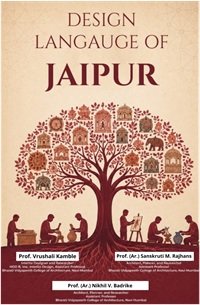
This book explores the rich history, architecture, interiors, craftsmanship, and cultural heritage of Jaipur’s iconic City Palace. It examines gateways, courtyards, arches, domes, jaalis, paintings, flooring, marble, stonework, and frescoes. It also highlights how Jaipur’s traditional architectural language can inspire contemporary interior design, creating a meaningful connection between heritage and modernity.
About The Author
Editor 1
Prof. Vrushali Kamble
Interior Designer and Researcher
HOD B, Voc. Interior Design, Assistant Professor
Bharati Vidyapeeth College of Architecture, Navi Mumbai
I am pleased to present this book on Jaipur’s rich architectural heritage, with a special focus on the City Palace, reflecting its historical, cultural, and design significance. My academic exploration of Jaipur, as an Interior Designer and Head of the B.Voc. Interior Design Department at Bharati Vidyapeeth College of Architecture, Navi Mumbai, deepened my understanding of planned urbanism, spatial hierarchy, and the integration of science, art, and culture envisioned by Sawai Jai Singh II. The palace’s intricate architectural elements reaffirmed that design is a powerful expression of function, craftsmanship, symbolism, and identity, while this collaborative work with students underscored the value of experiential learning and critical heritage documentation. I hope this publication inspires readers to appreciate, preserve, and learn from India’s remarkable architectural legacy with curiosity, respect, and scholarly insight.
Editor 2
Prof. (Ar.) Sanskruti Milan Rajhans
Architect, Planner, and Researcher
Assistant Professor
Bharati Vidyapeeth College of Architecture, Navi Mumbai
Architecture education is enriched through experiential learning, and our academic study tour to Jaipur provided students with valuable insights into its planned urban fabric, architectural heritage, and interior design traditions. Exploring landmarks such as the City Palace and Hawa Mahal strengthened their understanding of spatial planning, craftsmanship, and cultural context beyond the classroom. This publication reflects their observations and encourages future designers to appreciate heritage with curiosity, responsibility, and critical thinking.
Editor 3
Prof. (Ar.) Nikhil V. Badrike
Architect, Planner, and Researcher
Assistant Professor
Bharati Vidyapeeth College of Architecture, Navi Mumbai
Jaipur, the iconic Pink City envisioned by Maharaja Sawai Jai Singh II, is one of India’s finest examples of planned urban development, where architecture, culture, and scientific planning blend seamlessly. Its grid-based layout, climate-responsive design, intricate craftsmanship, and vibrant public spaces offer invaluable lessons in architecture and interior design. This book presents Jaipur as a living design laboratory, highlighting its architectural richness, cultural narratives, and spatial intelligence through academic exploration. We hope it inspires readers to appreciate the city’s enduring heritage and develop a deeper understanding of context, design, and the relationship between people and place.



Reviews
There are no reviews yet.